WHAT PLACEMENT ACTUALLY DECIDES
Placement is usually the last decision people make and the one that changes the tattoo most. The same drawing reads differently on a shoulder than on a finger, not because the art changed but because the skin did. Four things vary by area: how much that skin moves and stretches, how much sun and friction it takes in a normal week, who sees it and when, and what you might want to put next to it in five years. Get those right and an average design ages well. Get them wrong and beautiful work goes soft early. Pew Research Center found in 2023 that nearly one in four US adults with a tattoo regrets at least one. Pew did not break down the reasons. Ask around a shop, though, and artists will tell you the regret usually attaches to size and location rather than to subject. People rarely stop loving the meaning. They stop loving how it sits on them. So treat placement as a design decision, not an afterthought at the counter.
ARMS: FOREARM, UPPER ARM AND SHOULDER
The upper arm and shoulder are popular for good reason. The surface is broad and fairly flat, the tissue underneath is muscle rather than bone, and the area lives under a sleeve most of the year, so it sees little sun. Line work holds its edges here about as well as anywhere on the body. It suits Japanese work, realism, traditional, anything that needs room to breathe. The forearm gives you high visibility and a natural elongated shape that flows with script, botanicals and geometric panels. Pain is low to moderate, with the inner forearm a little sharper than the outer. Its real enemy is UV, since it is exposed most days you wear short sleeves. The two sides trade advantages. Outer forearm skin is thicker and holds a crisper line, but it faces up and takes the sun. Inner forearm skin is softer, so fine detail can settle less sharply, though it stays shaded and often keeps its contrast longer. The inner bicep is softer and more sensitive, and ink can settle a touch less crisply, which is why artists often keep detail there simple.
INNER WRIST, HANDS AND FINGERS
The inner wrist is a small, gentle, very visible canvas, and it is where a lot of first tattoos and memorial dates go. Skin there is thin and close to bone, so pain is brief but sharp, and fine lines under a millimetre can soften faster than they would on the forearm. Keep spacing generous. Hands and fingers are a different proposition. That skin regenerates quickly, gets washed dozens of times a day, and takes constant friction, so ink commonly fades and patches within the first one to three years, especially on the sides of fingers, on knuckles and anywhere the skin creases. Many artists will only do hands in bold, simple, well spaced designs, and many quote touch-ups as an ongoing expectation rather than a one-off. None of that means do not do it. It means go in knowing you are signing up for maintenance, and choose a design that still reads when the finest lines go.
BACK, SHOULDER BLADE AND SPINE
The back is the largest uninterrupted canvas on the body and the one that ages best. It gets little sun under normal clothing, the skin is thick, and it does not fold or stretch the way a waist or an inner elbow does. That combination is why serious large scale work lives there. Pain varies by zone. The fleshy upper and mid back is mild. Directly over the spine, over the shoulder blades and along the lower ribs at the sides, the needle sits close to bone and the vibration is felt more. A back piece is also the tattoo you will see least, usually in a mirror and at an angle, so ask your artist for photographs at the end of each session. If you are planning something ambitious, the back rewards patience. Large compositions are often built over several sittings across months, with healing time in between, and the finished piece is designed as one thing rather than assembled from parts.
CHEST, STERNUM AND RIBS
The sternum gives a chest piece a natural centre line to build around, although the two sides of a chest are never truly identical, so an experienced artist adjusts a symmetrical design to sit straight on the body in front of them. Upper chest below the collarbone is a comfortable area with solid, stable skin. Move inward to the sternum and it changes, since there is very little padding over bone and you are breathing under the needle the whole time. Ribs and the side of the torso are the same story. Most people describe rib work as the sharpest sitting they have had, and sessions there tend to run shorter because of it. The reward is a beautiful flowing canvas for vertical script, florals and long compositions that follow the curve of the body. Aging on the ribs and chest is generally good, since clothing keeps sun off. The one thing to plan for is body change, because the torso is where weight and muscle shift show up most clearly. Chest tattoos on larger busts also move, so placement should be chosen standing up, not lying down.
THIGH, CALF AND ANKLE
The thigh is one of the most forgiving canvases on the body and an underrated place for a first big piece. There is plenty of surface, plenty of soft tissue, low sun exposure under most clothing, and enough room that an artist can size a design properly instead of compressing it. The outer thigh is milder to sit through than the inner. The calf is similar, with a broad muscular back and a bonier shin, and it takes sun in summer, so it fades faster than a thigh does. Ankles are sharper, because the bone is right there and the skin is thin over it. Ankle and foot tattoos also live under socks and shoe edges, and that steady rubbing wears line work at contact points. Anything wrapping the ankle bone needs a design that survives distortion where the skin pulls. Feet heal slowly for the simple reason that you keep walking on them, so plan the appointment for a quiet week.
PAIN AND DIFFICULTY, AREA BY AREA
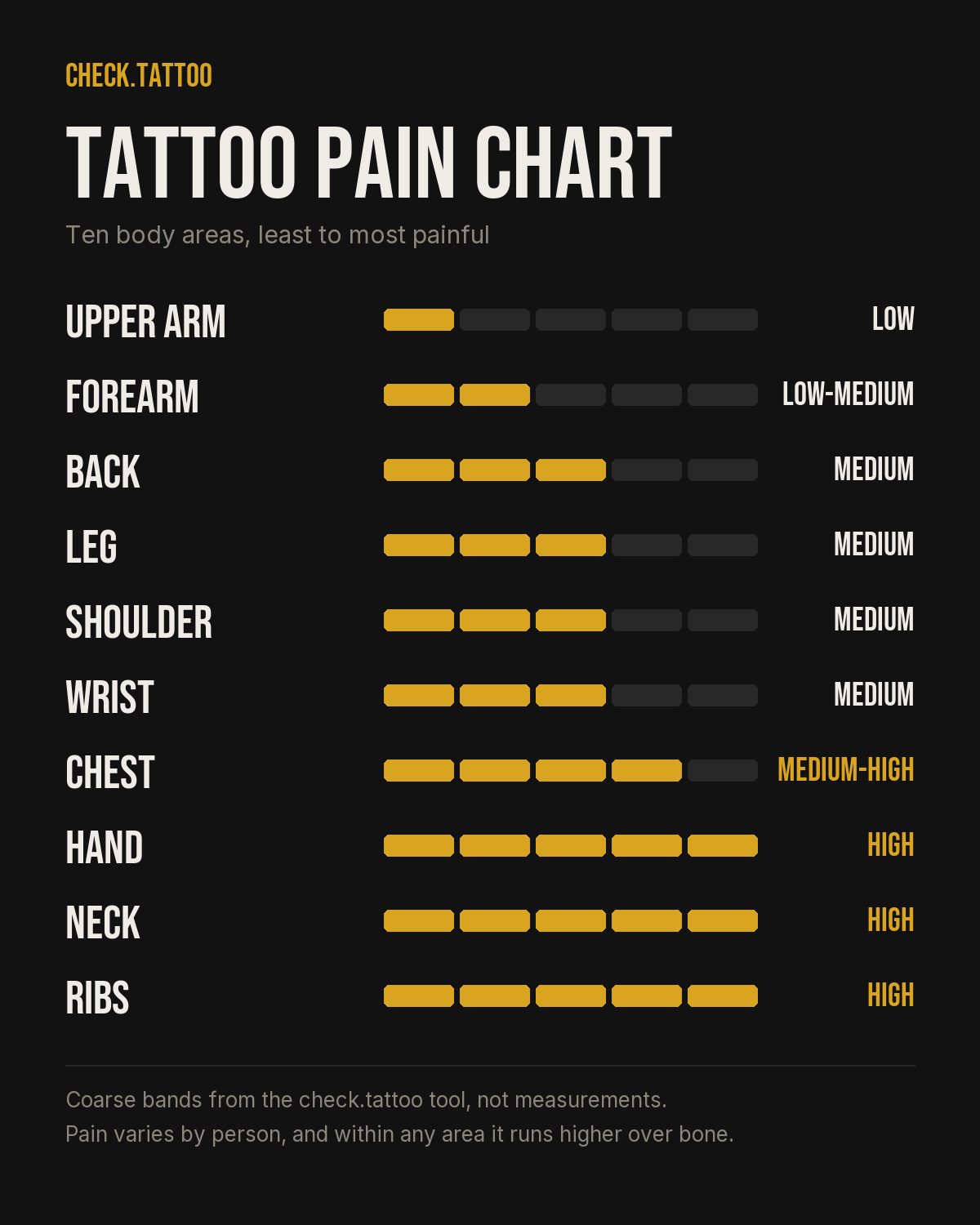
Pain is real but it is short, and it is far more manageable than people expect once they are in the chair. As a rough map, the outer arm, outer thigh, calf and forearm are the gentle areas. The upper back, shoulder and outer chest sit in the middle. Ribs, sternum, spine, the inner elbow, the back of the knee, the armpit side, hands, feet and the ankle bone are the sharp ones, because skin is thin and bone is close. Difficulty for the artist tracks the same map, plus stretchiness. Hands, fingers, feet, elbows, knees and inner biceps are technically demanding because the skin moves and takes ink unevenly, so those pieces take longer, cost more, and are likelier to need a touch-up. Ask when you book how long the sitting will run and whether it is split. Eat properly beforehand. If you are considering a numbing product, clear it with your artist first, since some change how the skin behaves under the needle.
WHAT CURVATURE DOES TO A FLAT DESIGN
Almost every design is drawn flat, on paper or a screen, and almost every placement is curved. That gap causes more disappointment than any other single thing. A perfect circle stencilled around a forearm becomes an oval from every angle except one. Straight horizontal lines across a bicep bend. Symmetrical designs wrapped around a wrist or ankle can never be seen whole, so the viewer only ever gets half. Designs that survive wrapping share traits: they flow along the limb rather than across it, they have a clear front facing focal point, and they tolerate the edges falling away out of view. Botanicals, snakes, waves, banners and vertical script all wrap beautifully. Rigid geometry, mandalas, lettering in a straight band and anything requiring precise symmetry are harder, and belong on flatter ground like the outer forearm, upper back, chest or thigh. A good artist will redraw the stencil on your body and ask you to move. Let them. That is the step that saves the piece.
STRETCH ZONES: WEIGHT CHANGE, MUSCLE AND PREGNANCY
Skin is not a fixed canvas, and some areas change far more than others over a life. The stomach, the sides of the torso, the upper inner arm, the inner thigh and the chest are the zones most affected by weight gain and loss, by pregnancy, and by significant muscle change. The forearm, calf, ankle, upper back, shoulder blade and outer thigh move comparatively little. If you know a big change is likely in the next few years, it is worth putting the piece you care most about somewhere stable, and keeping stomach and lower torso plans for later. Designs with tight repeating detail and precise symmetry show stretching first, since the eye reads any distortion in a grid immediately. Organic shapes hide it. None of this is a reason to postpone a tattoo indefinitely. Bodies change with or without ink, and plenty of work sits happily through pregnancy and weight shifts. It is simply information worth having before you pick the spot.
SUN AND FRICTION BY AREA
UV is the fastest way to age a tattoo, and exposure is entirely a function of placement. Hands, forearms, the back of the neck, the shoulders, the upper chest and the calves take the most sun in a normal year. Thighs, ribs, back, upper arms and anything under everyday clothing take the least, which is why those areas still look sharp a decade in. Friction does quieter damage in specific spots: the waistband line, under a bra strap, the ring finger, the shoe line across the top of the foot, and the inside of the ankle. Once a tattoo is fully healed and your artist says it is ready, sunscreen on exposed pieces is the single highest value habit you can build. It is a small habit, and on an exposed piece it is the clearest difference between line work that still reads clean years later and line work that quietly needs a rework. Follow your artist's aftercare instructions while it heals, and see a doctor if anything looks infected.
VISIBILITY, WORK AND WHAT JOB-SAFE MEANS IN 2026
Visible tattoos are broadly normal now, and in most fields nobody looks twice at a forearm. The line has moved, but it has not disappeared, and it moves at different speeds by industry. Creative work, tech, trades, hospitality and much of retail are effectively open. Client facing finance and law, some corporate and government roles, parts of healthcare with uniform policies, aviation crew, and certain international employers still have written rules, and those rules usually name hands, neck and face specifically. Neck tattoos and behind the ear pieces sit right on that line. Behind the ear is the quiet option, hidden with hair down and visible when it is up, though the area fades a little faster because of hair, friction and sun on the hairline. A practical test before you commit: look at what shows in a short sleeved shirt, in an interview outfit, and in the top third of a video call frame. If it is invisible in all three, the question is settled.
WHERE A FIRST TATTOO GOES, AND WHY
For a first piece, the outer or back forearm, the upper arm, the outer thigh, the calf and the shoulder blade are hard to beat. All five are flat enough to keep a design honest, easy to keep clean while healing, and easy to cover or show as you choose. Four of the five sit on muscle rather than tight over bone; the shoulder blade is bonier, but it is broad and flat enough that a design still lands cleanly on it. They also let you sit two or three hours without the session becoming an ordeal, which matters because your first tattoo teaches you how you handle the chair. The forearm has one extra advantage that people underestimate: you can see it. A piece you look at daily is a piece you bond with, and that early attachment is a real part of long term satisfaction. Ribs, sternum, hands, feet and neck are all wonderful placements and plenty of people start there happily. They just ask more of you at every stage, from the sitting to the healing to the touch-ups, and they are easier the second time around.
THINKING TWO TATTOOS AHEAD
Most people who get one tattoo get another, so choose the first spot as if there will be a second. The common regret is not the piece itself but where it landed, stranded in the middle of a forearm you later wanted to sleeve, at an angle that fights everything around it. Sleeves are built as one composition, with an anchor piece and flow through the bicep, elbow and wrist, and a good artist can design around existing work if you tell them the plan. Leave breathing room. Ink needs negative space to stay readable, and a limb crowded with unrelated small pieces is the hardest thing to unify later. If you are unsure whether an idea belongs on the forearm or the thigh, running it through a free check on check.tattoo will give you a second opinion on placement, size and how it may age before you sit down. It is a prediction, not a verdict, but it is a useful thing to bring to the conversation with your artist.